Rippling is a $14B company doing several hundred million in ARR.
Outbound sits above 50% of revenue with a plan to reach 60%.
Their CRO, Matt Plank, started by making cold calls from Parker Conrad's basement.
Everything below is public, from Plank's own talks and podcast appearances.
The structure transfers to any company with a large TAM and a deal size that supports a sales team:
Phase 1: Programmatic Outbound

In the early days Rippling ran programmatic outbound,
meaning marketing led automated outreach with no SDR team behind it.
You build a database, buy the tools, and the marginal cost per account lands close to zero.
For a company that cannot yet fund a sales org, that is the CORRECT first move.
The performance from that period:
1,000 accounts contacted produced 5 to 10 demos
Conversion sat at 0.5 to 1%
Inbound SDRs engaged whoever responded
Those SDRs carried quotas of 50 to 60 demos a month
Plank describes it as transactional and CAC efficient.
Their TAM was effectively unlimited at that stage, with hundreds of thousands of accounts available,
so a 1% conversion rate still produced enough volume to grow against.
If you are early with a large market, run this first.
You are buying data on your market at the lowest possible cost, and the low conversion rate is acceptable while the cost per attempt stays near zero.
Track 2 numbers while you run it.
Your conversion rate, and how many accounts in the database remain unworked.
The second number is the one that expires.
The reason conversion stays low here is that nobody is doing account-level work.
No research, no personaliztion beyond a variable, no phone.
You are trading conversion rate for cost per attempt, and at this stage that trade is correct.
The Ceiling They Hit:
They ran out of ACCOUNTS.
At 0.5 to 1% conversion, hitting the next year's growth target required more accounts than the database contained.
That is the structural limit of programmatic outbound.
Growth is capped by TAM multiplied by a conversion rate nobody is working to improve.
At that wall you have 2 options.
Expand the TAM, meaning new markets, new segments, new geographies.
Or raise the conversion rate on the accounts you already hold.
Rippling chose the second.
Expanding the TAM buys you time and keeps the conversion rate where it is.
Raising conversion changes what the channel is capable of producing on the market you already have.
At their point, with hundreds of thousands of accounts already in the database and yield as the constraint,
the second option was the ONLY one that moved the number.
Plank has said publicly that waiting so long to start was a mistake, and that outbound should be built 9 to 12 months before you need it.
They built it under pressure.
Ashley Kelly was hired to construct the SDR organisation from scratch with the growth target already committed.
Building an SDR org takes 6 to 12 months to produce results, so a company that starts when it needs pipeline is already 3 quarters late.
Plank's estimate for an effective outbound team is 20 to 50 SDRs, and each one needs ramping and training before they produce.
That timeline is the argument for starting early.
The cost of building outbound before you need it is a quarter of spend.
The cost of building it late is a missed YEAR.
Phase 2: Human Led Outbound:

Over 18 months they built a 150 person outbound SDR organization from zero.
The build included the layer around the reps:
SDRs carrying the outreach
Managers supporting them
Directors above the managers
VPs above that
Companies budgeting for an SDR team usually price the reps and forget the rest.
A 150 person org needs roughly a manager per 6 to 8 reps, directors above them, and VPs above that.
Budget the full structure or the reps underperform.
The result on the same accounts that were converting at 1%:
Conversion moved to 3 to 7%.
The database, the market, and the product were unchanged.
30 to 70 demos per 1,000 accounts against the 10 they were getting before.
They now book roughly 1,300 outbound demos a month, with roughly half still happening over the phone.
Plank's read on why the phone works: cold calling has become close to a lost art, which is what makes it effective now.
Competitors moved to automate everything.
Rippling found the advantage in human persistence and creativity.
He is direct about the AI question too.
His position is that humans outperform AI on outbound, and that anyone claiming automated emails and marketing forms alone can scale a business has not scaled one.
Worth reading that alongside phase 1 rather than against it.
They ran the automated version for years and it worked at the stage it suited.
The claim is about what automation alone produces at scale, and their own numbers demonstrate the gap.
How They Tier The Market:
Running 150 SDRs against a large TAM requires deciding where the expensive effort goes.
They split prospects into tiers based on potential value.
Tier 1 gets account-based SDRs doing genuine research and personalised outreach
Tier 2 and 3 get automated email and AI assisted outreach at lower cost per account
Tier 1 produces 3 to 7x the meetings of the programmatic program.
Their mid market deals average around $45,000 a year, which funds real research time per account.
Run that calculation on your own numbers before copying the structure.
At a $45k ACV, an hour of SDR research per account is trivial.
At a $4k ACV it consumes the margin.
5 data engineers maintain and score the TAM.
Their market is a living asset with dedicated headcount attached, rather than a quarterly export,
and that is what makes accurate tiering possible at their volume.
The tiering also decides what gets automated.
The accounts where AI assisted outreach makes sense are the ones where a human hour cannot be justified,
so the automation question answers itself once the tiers exist.
Build the tiers on things that indicate value and timing together.
Headcount and revenue band, the function you sell into, and any live signal like funding, a relevant hire, or an expansion.
An account with 3 of those sits in Tier 1.
An account with none goes to the automated motion.
How Outbound Is Structured Internally:
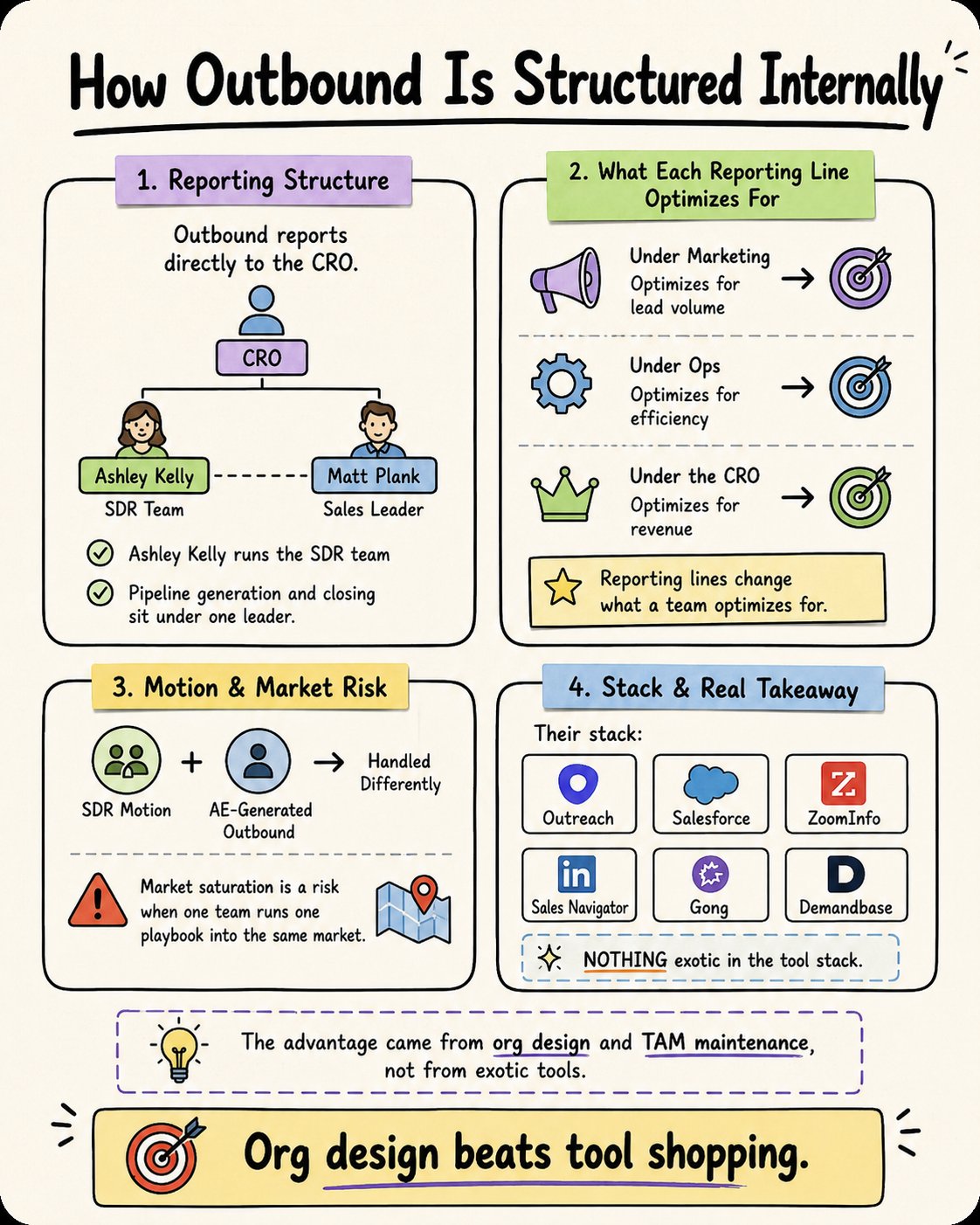
Outbound reports directly to the CRO.
Ashley Kelly, who runs the SDR team, reports to Matt Plank, so pipeline generation and closing sit under one leader.
Reporting lines change what a team optimizes for.
Under marketing, outbound optimizes for lead volume.
Under ops, it optimises for efficiency.
Under the CRO, it optimises for revenue, and the SDR and AE incentives stay aligned.
They also run AE generated outbound alongside the SDR motion, handled differently.
Plank's reasoning is market saturation.
When every touch into a market comes from one team running one playbook, the market burns faster and every account sees the same approach.
Their stack:
Outreach
Salesforce
ZoomInfo
Sales Navigator
Gong
Demandbase
NOTHING exotic in that list.
The advantage came from the org design and the TAM maintenance rather than the tooling, which is worth noting before you go shopping for a fix.
What To Take From This:
Start programmatic if you are early.
Low cost per attempt, and you learn your market while spending almost nothing. Accept 0.5 to 1% conversion for what it is.
Track your remaining accounts.
Programmatic caps out on database size, so that number tells you when the model expires.
Build outbound 9 to 12 months before you need it.
Their CRO called waiting a mistake. An org takes 6 to 12 months to produce, and building it against a committed number produces a rushed team.
Budget for the org.
150 SDRs came with managers, directors, and VPs. That support layer is what separates a team from a headcount line.
Tier by deal value and check the arithmetic.
Personalized outreach at 3 to 7x the meetings works when your ACV funds the research hours.
Put permanent headcount on the TAM.
5 data engineers maintaining and scoring the market is what lets 150 reps work the right accounts.
Report outbound to revenue.
It changes what the team optimises for.
Run more than one motion into the market.
SDR generated and AE generated outbound together slows saturation and gives accounts more than one way in.
Every phase they ran was correct for the stage they were in.
The mistake was timing the transition between them. VOLUME NEGATES LUCK.
If you want an in-house GTM team running your lists, infrastructure, sending, replies, and your entire market contacted every 90 days, Book a Strategy Call.