Verkada sells security cameras, door access, sensors, and alarms to businesses.
In December 2025 it was valued at $5.8 billion, in a round led by Alphabet's growth fund CapitalG.
It has 30,000+ customers, including more than 91 Fortune 500 companies.
Between September 2022 and February 2025, its customer count grew 111% and its revenue grew 95%.
Our own team has sent 10M+ cold emails and made 700k+ cold calls for more than 100 B2B clients, creating $70M+ in pipeline.
Here is how Verkada sells, and what you can copy.
Play 1: let software do the first touch, and people handle the replies:

Verkada wrote about this play on their own blog.
How it used to work.
Each SDR had their own set of leads in one territory and one time zone.
They spent a big part of their day sending first emails, calls, and LinkedIn messages.
What they changed.
They created a new role called the Market Development Representative, or MDR.
The growth team automated the first outreach across email, calls, and LinkedIn.
An MDR only steps in once a prospect replies.
MDRs are also free to work replies from any territory or time zone, so they always work the warmest leads first.
According to Verkada, this saves MDRs hours every day, which they spend talking to prospects.
The results, from Verkada's own data.
MDRs book about 6 qualified meetings a day, compared with about 1.5 for their SDRs.
That is close to 120 meetings a month per MDR, compared with about 20 for a typical SDR.
The program lasts 10 months and was built to deliver 4 times the return of their SDR program.
The write-up was published by Idan Koren, who led marketing at Verkada.
We saw the same jump with one of our clients.
One client, a lender whose customers are small businesses, arrived booking around 1 SQL a day.
We focused their outreach on the lending segments that fit best, wrote scripts for each use case, rebuilt their sending setup, and sent 100,000+ emails a month.
Within the campaign they were booking 6+ SQLs a day, and 186 interested leads came through.
Software covered the market, and people worked the replies.
How to set up your own version
You can use the same split without a big team.
Software handles:
Building and checking the list
Finding and verifying emails
Sending the email sequence
Queuing LinkedIn messages
Catching replies and sorting them
People handle:
Answering every positive reply within the hour
Calling every interested prospect
Checking they are a real fit
Booking the meeting and briefing the salesperson
How a reply gets from software to a person:
When a reply arrives, an automation catches it instantly
It goes into the CRM with the full email thread
Positive replies are posted in a Slack channel with a named owner
The owner calls the prospect
On our campaigns, calling at this point gets close to 90% of people to show up, compared with around 40% when they only get a booking link.
What the person's day looks like:
They open the reply queue, sorted by how interested and how recent each reply is
They call positive replies within the hour
"Later" replies get a follow-up date
"Wrong person" replies get asked for the right name, who is added the same day
The rest of the day goes to follow-up calls and briefing salespeople
The number to track.
Meetings booked per person per day, the same number Verkada used.
If it sits around 1.5, your people are still doing work software should be doing.
Why speed matters so much.
Velocify found that reaching a lead inside the first 60 seconds can lift conversion by up to 391%.
A 2011 Harvard Business Review study found companies replying within an hour had roughly 7 times the odds of getting a decision maker on the line.
The whole setup depends on people replying fast once software brings in the replies.
Play 2: run a separate campaign for each type of buyer:
Verkada's growth team targets narrow groups, such as IT directors, homeowners associations, and industrial businesses.
Each group buys security for different reasons and describes it differently.
The problem they had.
They had lots of campaign ideas but limited time to research each group.
How they fixed it.
According to Clay's case study, Verkada's growth team uses Clay to run targeted campaigns across LinkedIn, email, and direct mail.
Research that used to take days now runs automatically, so they can launch a new campaign whenever they have an idea.
How to do this yourself.
Group companies by the problem they share.
An HOA board and a factory manager both buy cameras, but for completely different reasons, so they need different messages.
Write one message per group, in their words, with a result from a customer like them.
Track the interested rate for each group and send more to whichever group responds best.
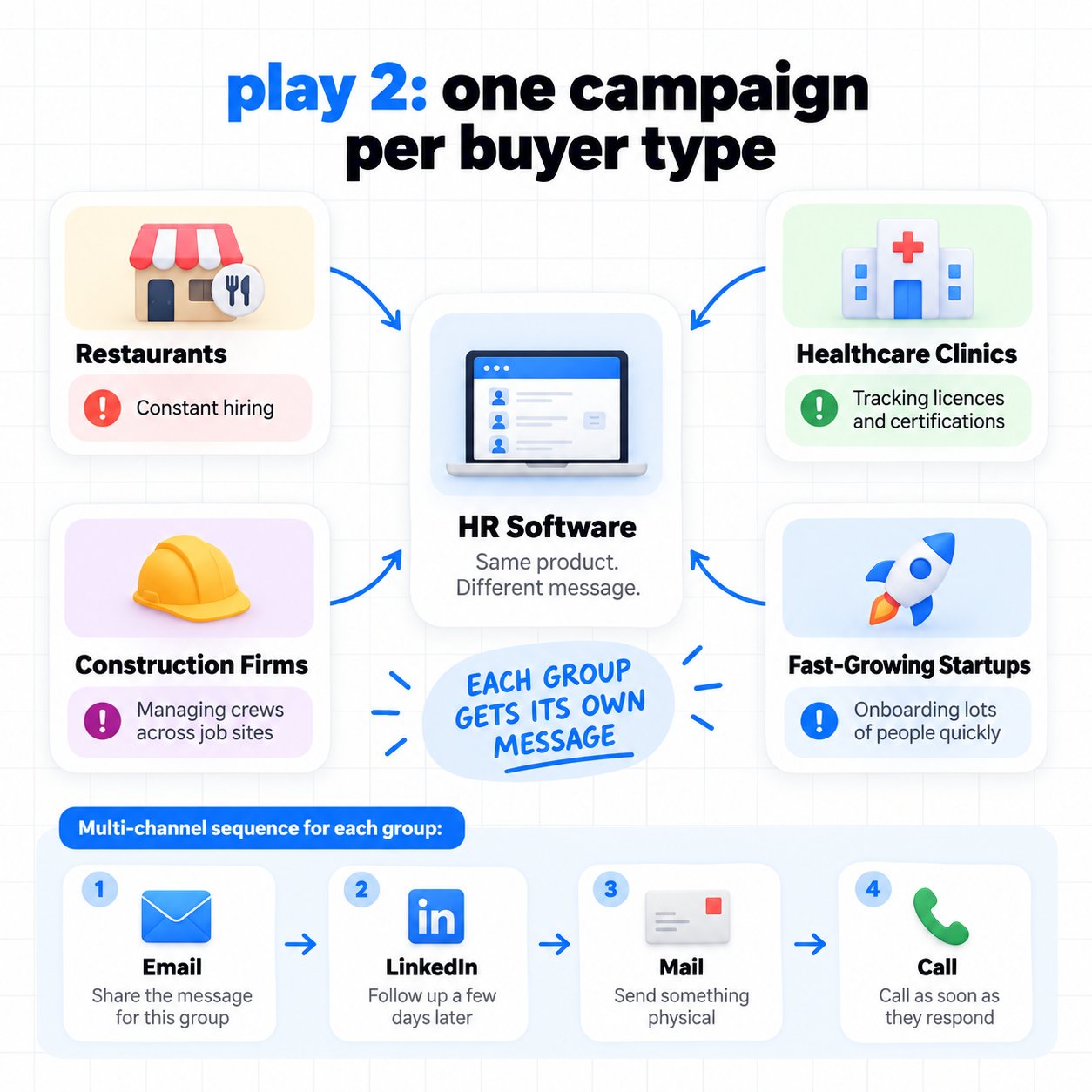
Example groups for a company selling HR software:
Restaurant groups with high staff turnover, where the problem is constant hiring
Healthcare clinics, where the problem is tracking licences and certifications
Construction firms, where the problem is managing crews across job sites
Fast-growing startups, where the problem is onboarding lots of people quickly
Each group gets its own message about its own problem, even though the product is the same.
How to combine channels for each group:
Email the decision maker about the problem their group shares
Send a LinkedIn message a few days later about the same problem
Mail something physical to the best accounts, like a printed report or a sample
Call as soon as they respond to any of the 3
Play 3: build a landing page for each prospect:
According to a breakdown of Verkada's growth strategy, the team automatically created personalised landing pages for prospects.
A page made for a prospect's company shows them exactly how the product fits them.
What to put on the page:
Their company name and industry in the headline
The problem their type of company has
A result from a similar customer
One next step, like booking a time or starting a trial
A model can fill in these details for thousands of prospects using the data you already have.
Link to the page in your second or third email, since links in a first cold email hurt deliverability.
Play 4: let buyers try the product first:
Verkada runs hardware trials, and describes its trial process as built to keep sales cycles short.
A buyer can install a camera and watch the footage from their own building before they commit.
How to apply this to any B2B company.
Give prospects a way to see the result before they buy.
Hardware: a trial unit
Services: a free audit, sample, or mockup made for them
Software: a report or small pilot using their own data
How to design your trial offer:
Pick the smallest part of your result a prospect can see within a week
Make sure you can deliver it cheaply, since you'll offer it to thousands of prospects
Put it in the first message as the thing they say yes to
Discuss the full deal on the call once they've seen it work
By the time they get on a call, they have already seen what you can do.
Play 5: sell through partners too:

Verkada also sells through security installers, called integrators.
Channel Sales Managers work with each partner on strategy, pipeline, training, and planning, which Verkada describes as more hands-on than its competitors.
Installers already work locally, so they give Verkada reach into areas its own team would take years to cover.
How to use this in your outbound.
Treat partners as a second market.
Make a list of the agencies, consultants, and resellers who already serve your buyers, and run outbound to them with the same system.
One partner who brings you 5 deals a year can be worth more than most single customers.
Play 6: train new salespeople in groups:
Verkada runs entry level sales programs with 2 roles: the Associate Account Executive and the Enterprise Development Representative.
New hires start in groups and train together on the product, the sales playbook, and live coaching.
Associate Account Executives usually move up to Mid Market Account Executive within 9 months,
and Enterprise Development Representatives within 12 to 18 months.
A company growing revenue 95% in under 3 years needs a steady supply of trained salespeople, and this program provides them.
How the 6 plays fit together:
Software reaches the market by email, phone, and LinkedIn
Separate campaigns reach each type of buyer with the right message
Landing pages and trials let buyers see the product working for them
MDRs turn replies into meetings fast
Partners reach regions beyond the team's own coverage
Training programs keep enough salespeople coming in
The MDR program sits in the middle, turning the interest the other plays create into meetings.
Selling to enterprise companies:

Verkada sells to more than 91 Fortune 500 companies.
Enterprise deals involve lots of people, and each contact is valuable, so you need both volume and accuracy.
What that looked like for one of our clients.
An enterprise focused B2B team came to us targeting companies worth billions.
Most big companies use Microsoft email, so we built them a sending setup that was mostly Microsoft, and sent to 48,565 contacts.
The result was 56 enterprise prospects asking for more, including conversations at Lionsgate and the San Diego Padres.
That is 867 contacts per lead, about 3 times what a mid market campaign needs.
What a $3M+ ARR company should copy:
Let software send the first touch and have people handle replies.
This is the biggest lesson from Verkada, and it works at any size.
Run a separate campaign for each type of buyer.
Each group gets its own list, message, and proof.
Offer something prospects can try.
A trial, audit, mockup, or pilot all work.
Treat partners as a market.
Run outbound to the companies that already sell to your buyers.
Track meetings per person.
Verkada compared 6 meetings a day with 1.5, and that number proved the program worked.
Pick your own key number and check it every week.
VOLUME NEGATES LUCK.
If you want help building and running an outbound system for your business, Book a Strategy Call.