I run an outbound agency and our team has collectively generated 30,000 leads + $70M in pipeline
This is the exact tech stack that we actually run, layer by layer, with what each tool does and the mistake that wastes it.
If you are building an agency, this is the best stack for you to use.
The layers, and why the order matters:
Sourcing feeds qualification.
Qualification feeds enrichment. Enrichment feeds verification.
Verification feeds sending. Sending feeds routing.
The weakest layer sets your ceiling.
Buying a better sequencer while your list quality sits at 55% fixes nothing. Diagnose before you buy.
Layer 1: sourcing:
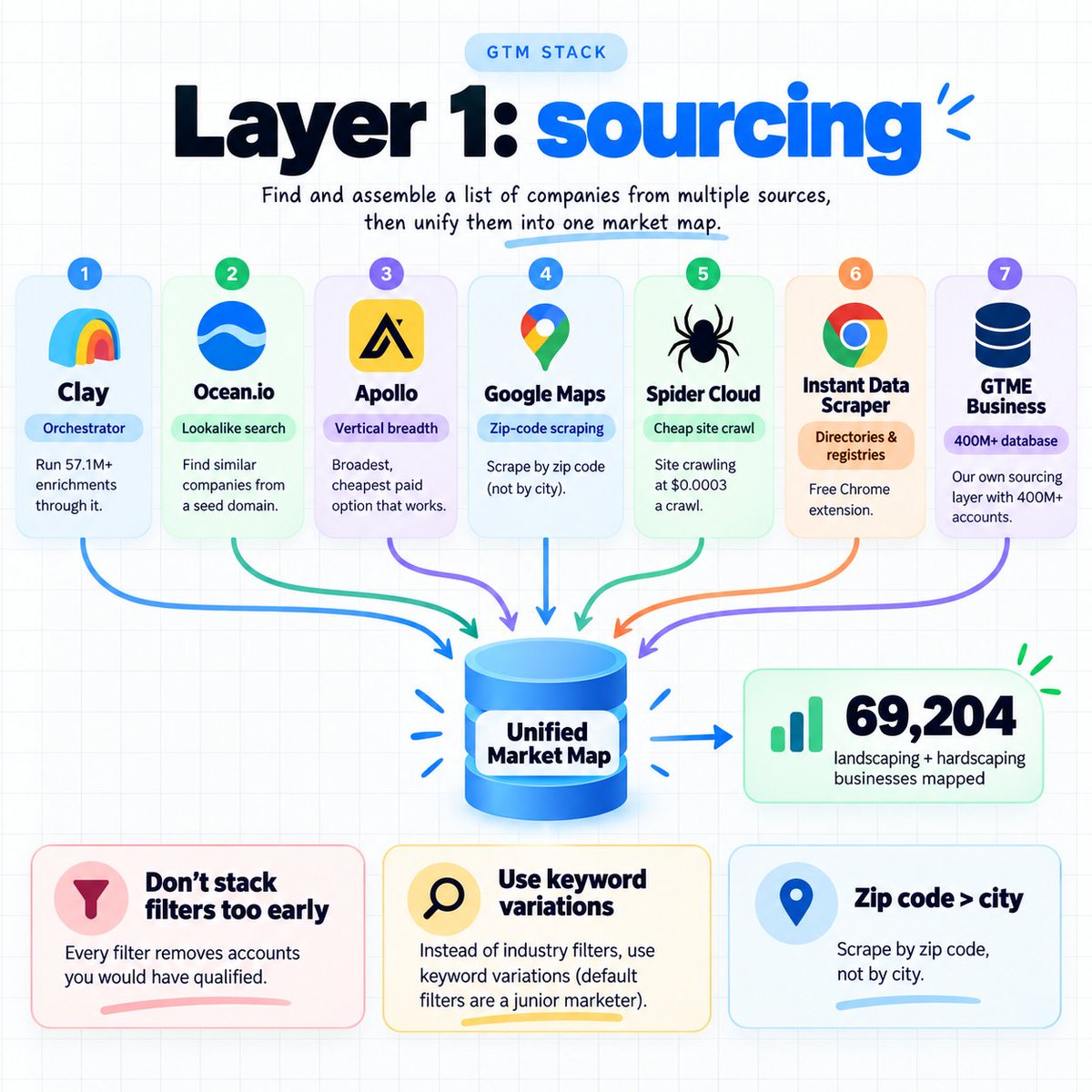
Clay.
The orchestrator, and where most of a GTM agency's list work happens.
We have run 57.1M+ enrichments through it.
Ocean(.)io.
Funded company filtering and lookalike search off a seed domain.
Seed it with your best 3 customers separately and compare the outputs, since one customer's lookalikes will be sharper than another's.
Apollo.
Breadth across a vertical, and the cheapest paid option that works.
The mistake: stacking filters at the source.
Every filter REMOVES accounts you would have qualified.
Use keyword variations over industry filters, since default filters return a Junior Marketing Coordinator when you asked for CMOs.
Google Maps.
Scrape by zip code and not by city.
Over 32,000 US zip codes, each returning its own set.
This is how we mapped 69,204 landscaping and hardscaping businesses for Eden Studio.
Spider Cloud.
Site crawling at $0.0003 a crawl.
Reach for it above 5,000 companies where Firecrawl bills start mattering.
Instant Data Scraper.
Free Chrome extension for association directories, licensing registries, and conference attendee pages.
The markets nobody has indexed.
GTME Business.
Our own sourcing layer, which is where the 400M+ account database sits.
Layer 2: enrichment and verification:

AI Ark.
400M+ accounts, and our first waterfall stage.
Icypeas.
Second stage.
Prospeo.
Clean, current data with strong coverage, and it runs standalone email finding outside any waterfall.
Claygent.
The reasoning layer inside Clay for anything requiring judgment on a record.
MillionVerifier.
Bulk verification before every send, keeping bounce rate under 1%.
BounceBan.
The second pass for catch-all domains, which report as deliverable and bounce anyway.
The principle behind running all of them.
Single source enrichment covers 50 to 60% of a list.
A stacked waterfall reaches 85%+. Verification takes it to roughly 99% deliverable.
Order the waterfall cheapest first, so expensive providers only run on what the cheap ones missed.
Pull 3 to 5 contacts per company, since title conventions vary and the owner at one company is the head of operations at the next.
Then scrape the public emails too.
On one market we found 3,621 business contacts and 4,553 non-business ones.
The non-business emails converted at 54.97:1 against 94.94:1 for the business emails.
125.7% more data at roughly twice the performance.
Run it from a separate sending instance.
Layer 3: email infrastructure:
ScaledMail.
Secondary Google and Microsoft inboxes with DNS, DMARC, and every authentication record handled.
At 167 domains, configuring 3 records each by hand is a week of work before a single email exists, and one wrong record silently kills that domain's placement for the life of the campaign.
EmailBison.
The sequencer. Isolated IPs, spintax, conditional logic, and reply detection that fires cleanly into your routing.
Holds at 10,000 a day.
The mistake: leaving open tracking on.
The pixel damages placement and returns a number you cannot act on.
Porkbun.
Domain registration. Cheap, clean DNS, no auto-renewal traps.
Have Claude generate 200 variations of the brand name, then bulk search those 100 at a time.
Gmail inboxes.
Google over Microsoft as the default, roughly 80/20.
The documented exception is enterprise, where we run Microsoft-skewed infrastructure because enterprise domains sit on Microsoft.
The protocol that keeps all of it alive:
1:1 inbox ratio, meaning 100 sending plus 100 on warmup reserve, rotated monthly
Warmup starts at 5 a day, +1 a day until 20
Cold ramp starts at 5 a day post-warmup, +1 a day
Steady state at 10 a day per inbox for longevity, 20 if crushing
Replace disconnected inboxes every month
Layer 4: calling:
Salesfinity.
The dialer.
Why this layer is not optional.
For Eden Studio, our cold calling produced 33 of 53 meetings off 32,577 dials against 41,150 emails.
Calling booked 62% of all meetings off 44% of the touchpoints, at a 9.2% connect rate.
Roughly 987 dials per meeting against roughly 2,058 emails per meeting.
Our base package is 25,000 emails a month plus 500 dials a day, producing 20 to 30 booked calls a month.
And calling converts what email earns.
Our 4 touch sequence between a positive reply and a booked meeting produces 75%+ show rates.
Calling a positive reply instead of sending a calendar link takes show rate from roughly 40% to 90% in our experience.
Layer 5: AI and orchestration:
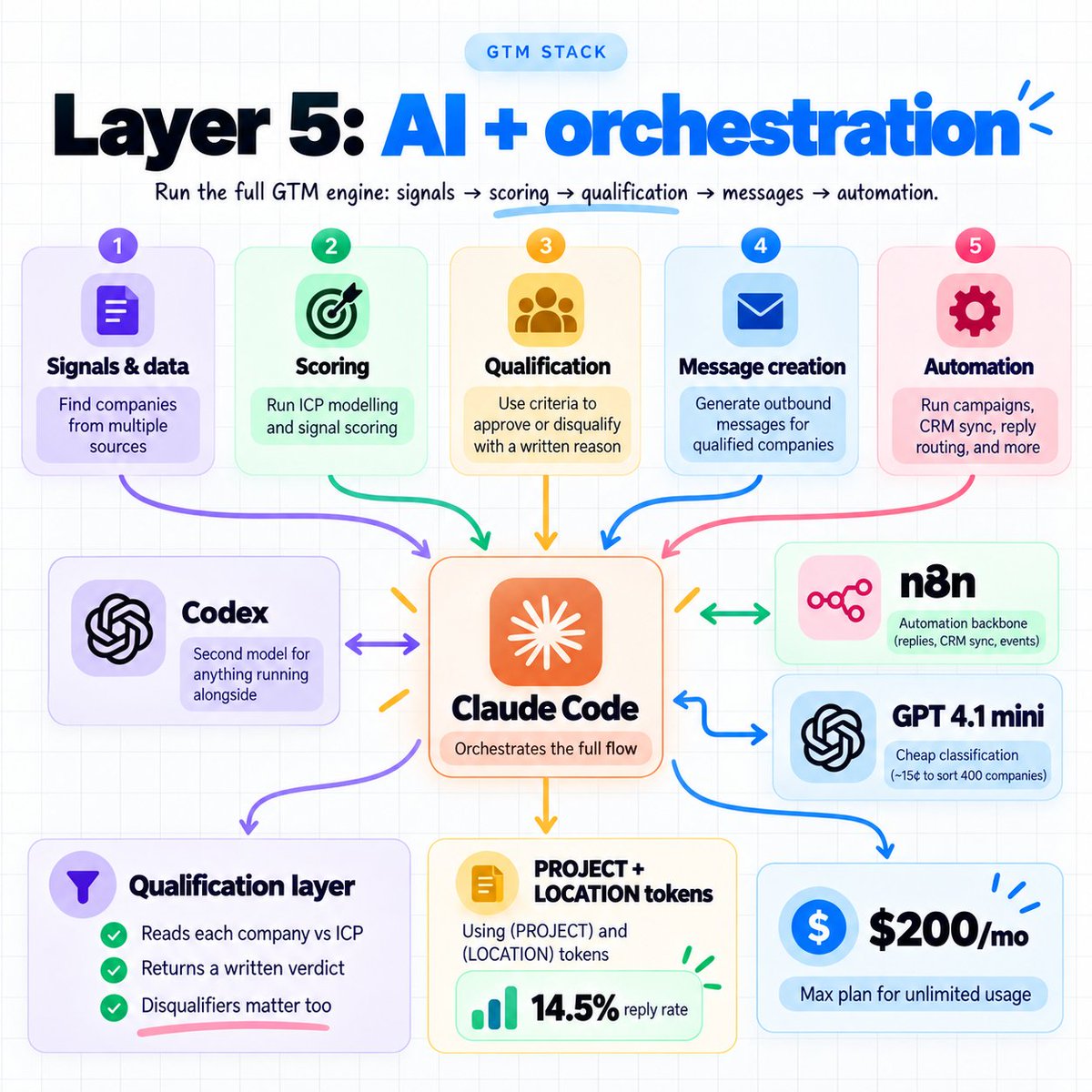
Claude Code.
$200 a month on the Max plan for unlimited usage.
It runs GTM strategy generation, ICP modelling, message creation, signal scoring, and qualification.
The highest leverage use is the qualification layer.
It reads each company against your ICP and returns a verdict with a written reason.
Write the disqualifiers with the same care as the criteria.
Without a definition of what your ICP is not, the model invents reasons a company qualifies.
It also does analysis no human has time for.
We had it analyse 4,055 cold email script variants across 1,160 campaigns.
One using {PROJECT} and {LOCATION} tokens hit a 14.5% reply rate against 1 to 3% for the generic version of the same script.
Codex.
The second orchestration model, for anything running alongside.
n8n.
The automation backbone. Reply routing, CRM sync, and anything event driven.
GPT 4.1 mini.
Cheap binary classification, at roughly 15 cents to sort 400 companies.
Run it first to cut obvious misses before a frontier model touches the file.
Layer 6: RevOps and routing:
Close.
The CRM on client engagements that need one.
HubSpot.
Where the client already runs it.
For the foodservice disposables manufacturer, positive replies scored automatically, pushed to Slack, and synced into HubSpot, with 86% of the 1,061 leads qualifying inside it.
OutboundSync.
Pushes every replying lead into the CRM the second it lands.
Sybill.
Call recording and analysis.
Slack.
Positive replies to a dedicated channel so a human is on them inside the hour.
Speed-to-lead decides the close rate.
Leads contacted within 60 seconds convert at up to 391% better according to Velocify's research, and Harvard Business Review's 2011 study found firms contacting within an hour were roughly 7x more likely to reach a decision maker.
The same reply volume produces zero closes or eight closes depending entirely on this layer.
If you are starting from zero:

6 tools get you a working agency.
Ocean.io for sourcing
Prospeo for contact data
ScaledMail for inboxes
EmailBison for the sequencer
HubSpot free tier for the CRM
Claude Code for everything else
Everything above that is incremental upside you add as client volume justifies it.
Then diagnose before you buy anything else:
Reply rate fine and volume small means the sourcing layer needs work
List large and reply rate under 1% means the qualification layer is loose
Both look right and nothing landing means run a placement test first
Fix one layer at a time and give it a full cycle.
Changing the list, the copy, and the infrastructure in the same week means you learn nothing from any of it.
The part the stack cannot give you:
Tools are the easy half.
The hard half is knowing how to actuall use these tools in the best possible way, and everything else associated with GTM and outbound.
If you want help building and running an outbound system for your business, Book a Strategy Call.