We've sent over 10 million cold emails and made 700k+ cold calls across 100+ B2B companies. And roughly 35 tools sit behind that. Every one of them does a single job, and they're wired so each hands off cleanly to the next. This is the walk from a company that doesn't exist in your CRM yet to a rep on the phone with someone who replied...
The rule that shapes the whole thing:
Most teams buy 50 tools and use 5. That happens because they buy platforms that promise to do everything, then discover each feature is a worse version of a specialised tool. Our rule is one tool, one job. Sourcing doesn't touch enrichment, enrichment doesn't touch sending, and sending doesn't touch the CRM. Each layer hands a CLEAN output to the next, and when one breaks you swap that piece without rebuilding the machine. Worth saying before any of this: if your Clay build is humming, leave it. If your sequencer is delivering, leave it. Campaign results are the only scoreboard. This is our stack, take what's useful:
Step 1: building the universe:

Before a single email exists there's a list of companies, and where you pull from depends on who you're selling to.
Ocean(.)io for funded tech. Series A through F, headcount ranges, geography, plus lookalike search off seed domains. This is the default for any funded SaaS TAM build.
Apollo for breadth. When you need a wide net across a vertical with firmographic and technographic filters.
Instant Data Scraper for the TAM nobody has indexed. Free Chrome extension that pulls association member lists, conference attendee pages, and directories where your best fit companies actually live.
Google Maps + Serper for local. Plumbers, dentists, gyms, accountants, pulled by category across an entire metro.
OpenWeb Ninja when Serper's 20 result pagination cap becomes a bottleneck. Up to 499 results per call.
The pick is SITUATIONAL. Funded tech goes to Ocean, breadth goes to Apollo, niche goes to the scraper, local goes to Maps, and depth goes to OpenWeb Ninja. The full TAM position we run only works because these five cover every kind of market between them.
Step 2: understanding who you just pulled:
A company name by itself is not a lead. You need to know what they do, what they sell, and what's happening there right now for it to be a lead.
Firecrawl is the workhorse. Hit a domain, pull the homepage, /about, /services, /case-studies, /careers. Every personalized prompt sits on top of this.
Spider at $0.0003 per crawl. Same job, cheaper, for when you're running scrape at extreme volume and Firecrawl bills get loud.
WaterCrawl as the third option, useful when the other two rate limit or choke on a specific domain.
Exa for semantic search. Ask it for companies that announced a product launch in the last 90 days and it understands intent in a way keyword search doesn't.
Serper for site specific queries. site:glassdoor.com, site:linkedin.com, job boards, anywhere keyword beats semantic.
Most runs fire Firecrawl and Exa in parallel, then Serper for the site specific lookups. Spider and WaterCrawl come in above 5,000 companies when the primary scrape starts costing real money.
Step 3: getting a verified human:
This is where most stacks quietly fail, and the failure shows up two weeks later as a bounce rate.
BlitzAPI is primary. Domain to LinkedIn company URL to ICP contacts to verified work emails, in one call. It replaced three or four tools we used to wire together, and it falls back through Prospeo and IcyPeas internally when its main source misses.
LeadMagic picks up whatever BlitzAPI couldn't resolve. Strong on niche industries and smaller companies.
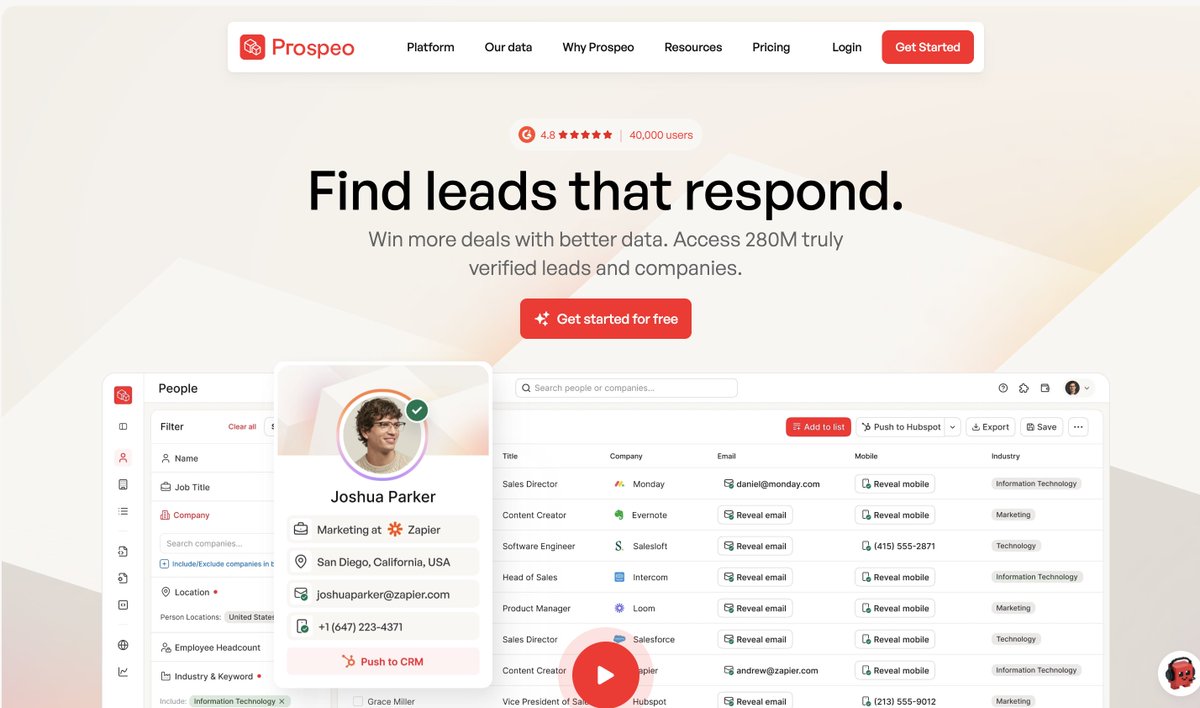
Prospeo(.)io standalone, for list only enrichment outside the BlitzAPI pipeline.
Icypeas as the third stage, catching what the first two missed.
Trykitt folded into the waterfall for the niche industries the big providers don't cover.
Apollo as the general directory fallback.
Then verification before anything sends:
Million Verifier for bulk scrubbing at roughly $0.0004 per verify.
Bounce Ban as the second pass, since it catches emails Million Verifier flags as risky. Both run on any list where bounce rate can't clear 1%.
Run the numbers on WHY the waterfall exists. Single source enrichment gets you 50-60% valid email coverage. The full waterfall gets 85%+ on the same list. Verification takes that to roughly 99% deliverable. That gap is the difference between hitting your send target and burning domains you spent six weeks warming.
Step 4: actually landing in the inbox:
Deliverability is infrastructure, not copy.
ScaledMail for secondary Google and Microsoft inboxes. $3 per Google inbox against $8 retail, and they monitor 75,000+ inboxes so nobody on our side is babysitting individual ones.
Sending(.)ac for Azure based inboxes. This is the third rail when you want diversity away from Google and Microsoft, and it's strong where the buyer base lives in Outlook.
ZapMail as another bulk provider in heavy rotation. Clean DNS provisioning, good placement, used alongside the other two for provider diversity at scale.
EmailBison for sequencing. Spintax, conditional logic, reply detection. It's the best high volume sender we've used.
PlusVibe as the backup sequencer, or for parallel campaigns that need separation.
Porkbun and Name(.)com for secondary domains. Cheap, clean DNS, no auto renewal traps.
The standing architecture:
ScaledMail provisions inboxes
Porkbun owns the domains
EmailBison runs sequences. 80% of volume on Google, 20% on Microsoft, and the primary domain never gets touched.
Step 5: the accounts worth more than an email:

Multi channel doesn't go on every campaign. It goes on the accounts that earn it.
HeyReach for LinkedIn outreach, meaning connection requests, DMs, profile views, post engagement.
Trigify for warm up plays before the DM lands. Post likes, profile views, comment replies, so there's familiarity in place before the ask.
Teamfluence if you'd rather one platform do both jobs instead of running HeyReach and Trigify together.
Calendly for booking plus the pre-call nurture, meaning confirmation and reminder cadence.
We reserve this for accounts scoring 50+ on signal scoring. Below that threshold, email only is more efficient, and spending LinkedIn touches on a low signal account is effort you could have pointed at a better one.
Step 6: what happens in the five minutes after a reply:
This layer decides whether reply volume turns into closes.
HubSpot as the CRM most clients run.
Close for phone first sales teams that want something lighter.
Attio for startups and product led orgs starting fresh, with a cleaner data model.
OutboundSync pushing every replying lead from EmailBison into whichever CRM they use, the second it happens. No manual entry or double touching a warm account.
Slack for reply notifications via webhook, with positive replies firing to a dedicated channel so a rep is on it inside five minutes.
Webhooks as the connective tissue, with EmailBison firing events, n8n routing them, and Slack plus the CRM updating in parallel.
Speed to lead is the WHOLE POINT of this layer. The same reply volume produces zero closes or eight closes depending entirely on how fast a human gets to it.
Step 7: the reasoning layer:
Claude Code on the Max plan at $200/mo, unlimited usage. This runs GTM strategy generation, ICP modelling, message creation, ABM lead magnets, signal scoring, and content production.
GPT 4.1 mini for cheap binary classification. B2B or B2C, keep or drop, sentiment. Roughly 15 cents to classify 400 companies.
Codex for the specific code gen workflows where OpenAI's models do better.
Clay as the orchestrator, still in place where it works, with the heavy lifting gradually moving to Claude Code.
n8n as the automation backbone for reply routing, CRM sync, and anything event driven.
Tella for custom video deliverables on priority accounts, meaning a personalized teardown per account.
Claude Code does the reasoning, GPT 4.1 mini does the cheap sorting, Clay holds what hasn't moved yet, n8n plumbs it together. If you were starting Monday with nothing, 6 tools get you a working machine.
Ocean(.)io for sourcing
Prospeo(.)io for contact data
ScaledMail for inboxes
EmailBison for the sequencer
HubSpot for the CRM
Claude Code for automation
Everything else on this page is INCREMENTAL UPSIDE you add as volume justifies it.
Also, if you want us to map, score, and contact your entire TAM using our AI native outbound system, Book a Strategy Call (must be doing at least $3M ARR).
We've generated over $70 million in pipeline value and sent 10 million cold emails for our clients.