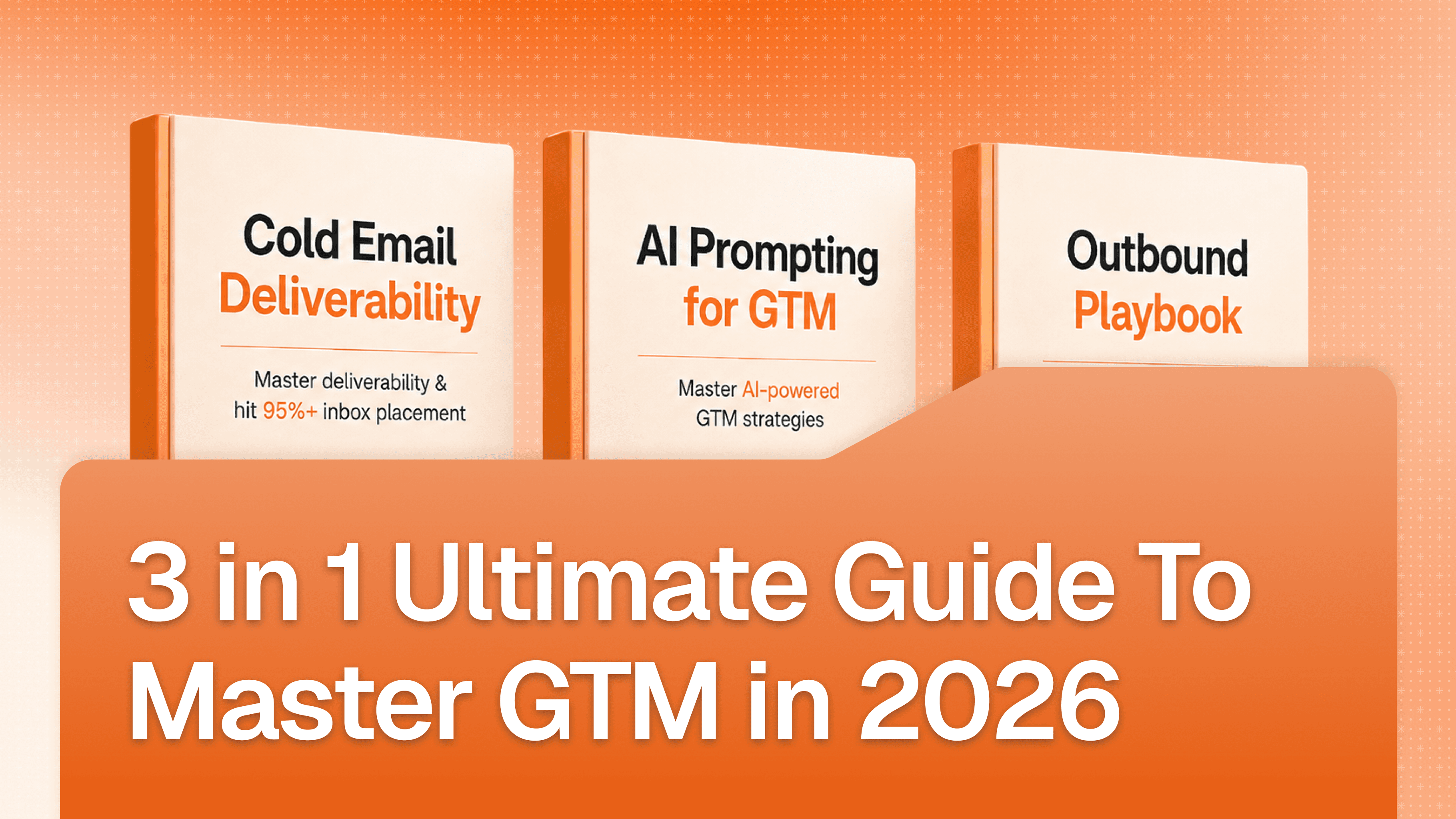
Most people treat cold email like a copywriting problem. Write a punchier line, tweak the subject, hope the reply rate moves. That's not where the leverage is. I've run outbound for over 100 B2B companies at Pipeline Tech, sent more than 10 million cold emails, and generated over 20,000 sales opportunities from it. The pattern is always the same. The teams getting results treat cold email as a system with five parts: research, offer, infrastructure, list, and messaging. Miss one and the whole thing underperforms no matter how good the other four are.
Here's the full system, in order.
Start With Research, Not a Sending Tool
Before you buy a sequencer or a list, answer three questions. Who are you actually trying to reach. Why would they care. Where do you find them. If you can't answer these clearly, you have a broken strategy before you've sent a single email.
Pull this from your own data first. Look at your closed-won deals and your sales call recordings, not your assumptions. You might think ecommerce is your best market when the data says it's actually SaaS. That single correction changes who you target for the next six months.
From there, build your ICP properly. An ICP isn't "SaaS companies." That's a market. An ICP is the specific team structure, buying signals, decision maker profile, and tech stack of the account most likely to become a great customer. For my own company, the qualifying signal is a sales team of three to ten people. Fewer than that and there's no one to work the leads we generate. Buying signals matter here too: a company hiring for SDRs is signaling they want more pipeline volume. A company that just raised funding is signaling they're about to spend on growth. Find the signal that maps to your offer.
Once the ICP is locked, map your TAM. A small TAM means you need to be surgical, every send matters, and you can't afford to burn through it carelessly. A large TAM gives you room to test aggressively because you won't run out of contacts before you find what works. If you're just starting out and don't have budget for a paid lookalike tool, a free Apollo account with your ICP filters plugged in, industry, minimum employee count, location, will give you a rough gauge of TAM size. Expect the exported list to only be around 60% complete without running it through a proper waterfall enrichment afterward.
One thing most people skip entirely: assess whether your offer even fits cold email as a channel. Ask yourself three things. Is the market saturated. Is it a demand capture offer, something people only want when they already have the need, like cybersecurity or insurance, or a demand generation offer, something almost anyone wants more of, like leads or revenue. And how differentiated is your solution against 500 companies saying the exact same thing. A saturated, demand capture, undifferentiated offer is the hardest possible starting point. Know that going in instead of finding out three months later.
The Offer Is the Highest Leverage Variable You Control
If deliverability is the floor, the offer is the ceiling. Most companies build their offer around what they want to sell instead of what the prospect actually wants. That's backwards. A strong cold offer is low risk, low effort, high upside, urgent, and quick to prove value.
Some offers sound smart and never work. A free 20-point audit from a total stranger. Nobody wants that unless you're a household name. "We can do everything for your marketing," the full replacement pitch, scares people instead of attracting them. "Your current system is broken, use ours instead" asks a stranger to rip out something they trust on the word of someone they've never met. These all fail for the same reason: they ask for more trust than a cold relationship has earned.
What works instead falls into three buckets. A sales asset, like a case study or teardown built off a result you've already generated for someone similar. A front offer, a scaled-down or free version of your real service that gets your foot in the door with zero risk to them. Or a direct offer with a guarantee, when your result is strong enough to state outright and back with a risk reversal.
The rule across all three: lead with the outcome they want, not the service you're trying to sell.
Infrastructure Is the Floor Everything Else Sits On
You can have the sharpest research and the best offer in your market, but if you're landing in spam, none of it matters. Deliverability in 2026 isn't optional groundwork, it's the gate everything else has to pass through first.
The short version: isolated sending infrastructure, a proper two-week warm-up before any cold sending starts, plain text only, no tracking pixels, no unsubscribe links, one follow-up per campaign with a three-day delay, and a reserve of backup inboxes because accounts will eventually burn no matter how careful you are. I go through the exact tool stack, warm-up schedule, and sending limits we run at Pipeline Tech in a separate infrastructure breakdown, since that's a deep enough topic to earn its own post.
List Building Determines Your Ceiling Before You Write a Word
Bad fuel means bad mileage. Your list doesn't just decide who you're reaching out to, it decides how specific your messaging can be. A broad list of "ecommerce brands" forces generic copy. A segmented list of "beauty brands running TikTok pixel with 20+ employees" lets you write something that actually resonates, because you know exactly who's reading it.
I pull leads from three sources. Online directories and Google Maps for niche or local data that databases like Apollo don't cover well, since a lot of small businesses never show up on LinkedIn. Dedicated databases like Apollo, Crunchbase, and BuiltWith for the standard stuff, though I'd rather run these through Clay than pay full price for a subscription. And lookalike tools, AI Arc being the best value, that build a list from a client domain you already know performs well.
Once you have companies, qualify them against your ICP criteria before you spend money enriching them. The more refined your ICP, the less you waste on enrichment and sends to people who were never going to convert.
Messaging: The Psychology Before the Framework
Cold email is the most honest feedback channel you'll ever get. People don't know you, so they say exactly what they think. And they're reading you at a subconscious level, in about five seconds, deciding whether you're another piece of spam or something different. If your email looks like the same 100 emails already sitting in their inbox, it doesn't matter how good your service actually is. You get classified as spam by pattern alone.
The prospect is only asking five questions when they open your email: does this make me money, have you done this for someone like me before, did you actually research my company, are you a real person, and is this a waste of my time. Answer all five in under 75 words and you have a strong email. I go deep into the six scripting frameworks, subject line rules, and CTA structure that answer those five questions consistently in a separate breakdown on cold email fundamentals.
One rule worth stating here directly: the worse your offer, the shorter your email needs to be. Adding friction to something already hard to sell only makes it harder.
Score Your Campaign Before You Launch It
Before you fire a single send, it's worth being honest with yourself about what result you can realistically expect. I break campaign performance down into five variables: playbook, context, offer, market, and deliverability. Playbook is whether you're running something proven, either by you before or by someone else in a comparable market, versus something completely untested. Context is how much real research went into your ICP and offer, not guesswork. Offer and market are largely about how saturated and how desirable your positioning is, and both are honestly somewhat out of your control. You can't spin a commoditized SEO offer into a 10 out of 10 no matter how you write it. Deliverability is close to binary: either your infrastructure is dialed and you're clearing a 2% reply rate, or you're landing in spam and everything else stops mattering.
Score yourself honestly across these five and you'll land somewhere in a predictable range. A campaign with a strong offer, a workable market, and everything else dialed in typically lands around one lead for every 300 to 750 contacts. A mediocre offer in a saturated market, even with perfect execution elsewhere, is more likely to land around one lead per 1,500 contacts. Below that, you're in territory where the offer or the market itself is the real constraint, not your execution, and no amount of copywriting fixes that. Running this assessment before you scale spend saves you from pouring budget into a campaign that was never going to clear a reasonable ratio.
Campaign Management Is Where Most Teams Actually Fail
Everyone tracks open rate. Almost nobody should, since the tracking pixel itself hurts deliverability. The four metrics that actually matter are reply rate, positive reply rate, bounce rate, and contact-to-lead ratio.
Reply rate is your clearest deliverability signal. Anything below 0.5% means something is broken, whether that's your list, your infrastructure, or messaging fatigue. Bounce rate should sit under 3%. Past 10%, you're risking domain reputation, not just wasting sends. Contact-to-lead ratio, the same number from the scoring breakdown above, is what actually tells you if the campaign is working, not vanity metrics like open rate.
Test in batches of 500 to 2,000 sends per variation before drawing conclusions. And when you find a script variation that's clearly carrying the campaign, kill the underperformers and put full volume behind the winner. I've seen that single move double a campaign's results overnight, because teams often keep running three dead variations alongside the one that actually works.
Speed to Lead Closes the Loop
Generating a positive reply means nothing if it doesn't turn into a booked meeting, and this is the step most people skip talking about entirely. Respond within five minutes. Wait past twenty and your conversion rate on that reply drops by 50 to 80%. That's not a small dip, that's most of your pipeline evaporating because a rep checked their inbox at the end of the day instead of the moment the reply came in.
Have reply templates ready for the five responses you'll actually get: interested, send more info, let's book a call, what's the cost, and wrong person. Always propose a specific day and time instead of a scheduling link. Links give people an easy way to say "I'll do it later" and then forget entirely.
Once a meeting is booked, protect the show rate. Cold outbound meetings aren't booked the way inbound ones are, the prospect didn't choose the time themselves, so they're more likely to forget. A confirmation email with a short video, reminders at 24 hours, 4 hours, 1 hour, and 10 minutes out, and never booking more than two or three days ahead will get you into the 70 to 80% show rate range, which is realistic for cold outbound. Expecting 90%+ without an SDR calling every attendee isn't realistic.
The Whole System, Not a Trick
None of this works as isolated tactics. Research without a strong offer gets you a well-targeted list that nobody replies to. A great offer without deliverability never reaches an inbox. Great messaging on a bad list wastes your best copy on the wrong people. The teams that actually win at this treat it as one connected system: diagnose, test, measure, cut what's losing, double down on what's working, and scale from there.
Everything above is exactly what we run for every client at Pipeline Tech. If you follow it end to end, you'll start booking more meetings from cold email. The information isn't the hard part. Implementation is.
I walk through this entire system, start to finish, in the full cold email course on YouTube.